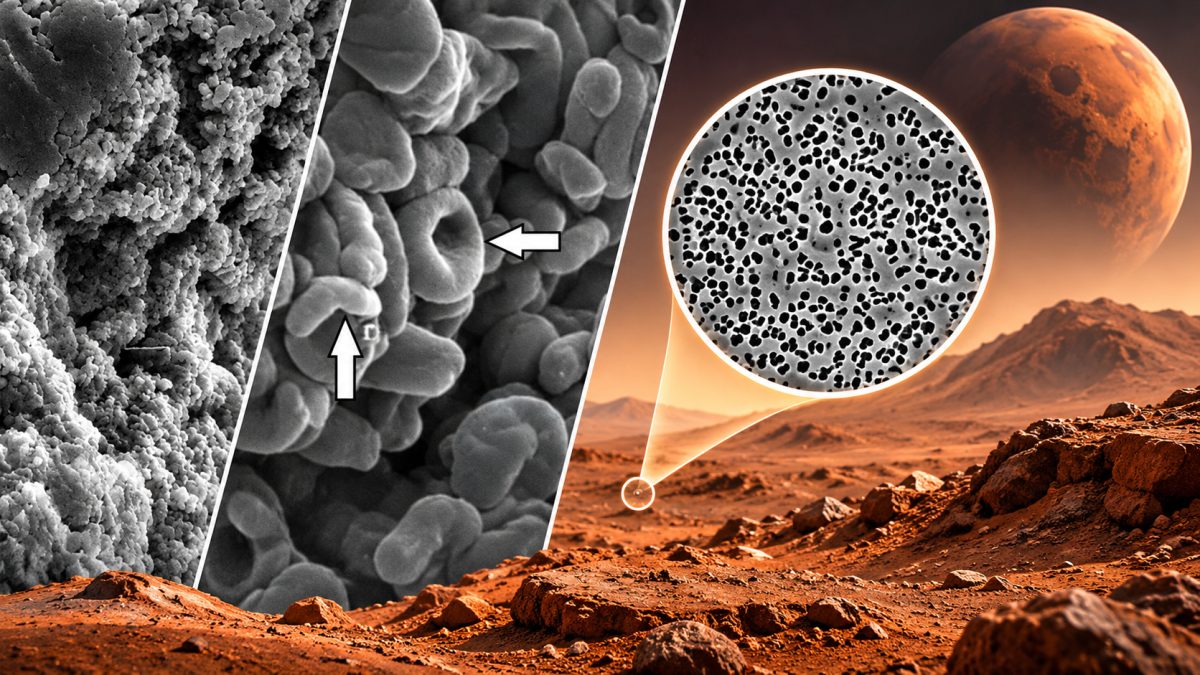

A tiny salt-loving microbe just spent 160 days proving it can grow under conditions scientists thought might only exist deep below the surface of Mars.
Researchers led by Adam Robinson at the University of Florida grew Haloferax volcanii under simulated Mars-like conditions for 160 days, watching the salt-loving archaeon multiply in a low-pressure, oxygen-free chamber. The study published in Applied and Environmental Microbiology on November 5, 2026, suggests Mars' hidden pockets might not be as empty as they look.
Would People Go to Mars Despite Health Risks? Most Readers Say No
How the Haloferax volcanii Mars-like conditions experiment worked
The team built a lab setup meant to copy a possible hidden spot under the Martian surface. They kept the cultures at just 24 millibars of pressure, about 2% of what we breathe on Earth at sea level. The chamber was packed with carbon dioxide and had no oxygen at all, matching what Mars' thin atmosphere actually looks like.
Instead of normal water, the microbes lived in a liquid roughly seven times saltier than seawater. That salty soup was meant to stand in for the kind of brine that might pool inside or beneath salt minerals on Mars. The whole experiment ran at a steady 21°C, which is about 70°F, far warmer than Mars itself usually gets, but useful for testing whether growth was even possible at all.
2,800-Year-Old Siberian Tomb Cannabis Find May Reveal a Dark Ritual Secret
Why nitrate and perchlorate made all the difference
Since there was no oxygen to breathe, the microbes needed something else to power their metabolism. The researchers gave them either nitrate or perchlorate, two chemicals that actually show up in Martian soil. Perchlorate is a strong oxidizer that's been detected by Mars missions for years, and nitrate is considered a realistic option for anaerobic life to use as a substitute for oxygen.
Both compounds worked. The team tracked rising optical density, basically how cloudy the liquid got as more cells grew, and confirmed the microbes were chemically breaking down the nitrate and perchlorate they were given. That's not passive survival. That's active feeding and reproducing. When the researchers left out both chemicals, the microbes stayed alive but stopped growing, showing just how much those compounds mattered.
Why this matters beyond one petri dish
Mars today is cold, dry, and blasted by radiation, with a surface where liquid water can't stick around for long. But scientists have long wondered about pockets hidden underground, maybe inside salt deposits, where briny liquid could survive longer, shielded from the worst of it. This experiment didn't prove that such pockets exist. It tested whether an organism built for extreme salt could theoretically make use of one if it did.
Haloferax volcanii was picked for a reason. It's already a model organism for studying salt-loving life on Earth, so scientists know its habits well. The fact that it kept growing, even if slower than usual, under this stacked combination of low pressure, no oxygen, heavy salt, and Martian oxidizers is the first time this exact mix has been shown to support real metabolic activity rather than just survival.
What scientists are careful to say, and not say
Nobody involved is claiming they found life on Mars. The language in the study is specific: this organism grew in simulated Martian conditions in a lab on Earth, not anywhere near the red planet itself. Coverage of the findings has repeatedly stressed that this result applies to one lab test of one microbe under one engineered set of stresses, not a full recreation of the Martian environment.
There are real gaps between this experiment and actual Mars. The lab never dropped to the freezing temperatures common underground there. It skipped radiation exposure entirely. It didn't use real Martian minerals or mimic the freeze-thaw cycles that would happen naturally. The nutrient-rich liquid used in the lab was also far richer in organic material than anything Mars is likely to offer. Researchers flagged all of this clearly, treating the work as an early step rather than a finished picture.
What comes next for Mars habitability research
The obvious next move is tightening the simulation. Future tests would need colder temperatures, actual Martian mineral analogs, tougher nutrient limits, and radiation exposure to see if growth still happens under those added pressures. Scientists may also try growing organisms inside solid salt or rock samples instead of liquid, which would look a lot more like what Mars could really offer.
There's also a practical side to all this. If Earth microbes can multiply under certain Mars-like stresses, spacecraft-cleaning rules might need another look. Any future mission hunting for real Martian life will need airtight ways to tell native organisms apart from hitchhikers that rode in from Earth. No new mission date or policy change has been announced in connection with this study, but the question it raises isn't going away anytime soon.