
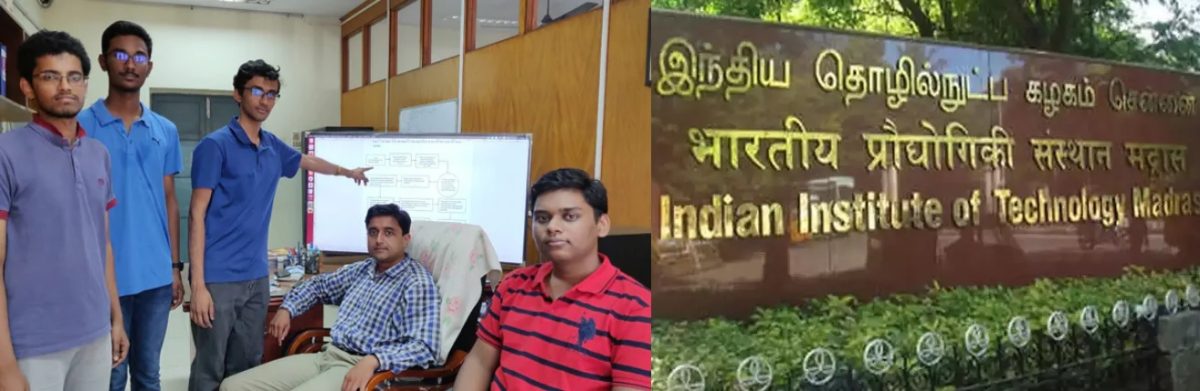

IIT RESEARCH TEAM, MADRAS DEVELOP AI TECHNOLOGY TO CONVERT BRAIN SIGNALS IN IMPAIRED POPULATION INTO HUMAN SPEECH
A BOON WITH AI TECHNOLOGY FOR IMPAIRED POPULATION INTO HUMAN
A breakthrough in technology was noticed with the recent use of artificial intelligence (AI) by a research team in Madras. Researchers at IIT Madras developed a technology with use of artificial intelligence to convert brain signals in impaired people into understandable human speech on Monday, 3 February 2020.
The entire research team consisted of technology researchers led by none other than Dr. Vishal Nandigana, an Assistant Professor of Mechanical Engineering at the institute. The entire research was carried out at Fluids Systems Laboratory, in Indian Institute of Technology (IIT) Madras, for testing the wave signals of the brain with help of AI and deep learning algorithms.
Brain signals are electrical signals, and any form of signals in nature can be decoded in wavelength format by the use of physical law or mathematical forms such as Laplace or Fourier Transform. These science-based languages developed by Isaac Newton and Jean-Baptiste Joseph Fourier were implemented as deep learning algorithms along with AI in decoding the brain signal wavelengths among impair people.
The output result is mostly in the form of ionic currents which see to speech in humans. This concept was used by the team in experimenting in the laboratory where nanopores in human were filled with saline water and subjected to the electric field so that electric signals could be derived from the nanofluid transport.
Researchers worked on real data signals to use brain signals to convert the spikes and humps to the English language. The research team involved in this outbreak of technology highlighted that it all depends on decoding the signal output from the brain. The researchers felt this is not limited to impaired people alone to understand what they wish to convey to us in simple English. It can even be applied to nature and plants to understand scope of earthquakes, floods and take measures for the same.
It is seen it all depends on decoding. Indeed technology with the integration of artificial intelligence has made an understanding of speech and communication possible by simply understanding the signals of the human brain.