
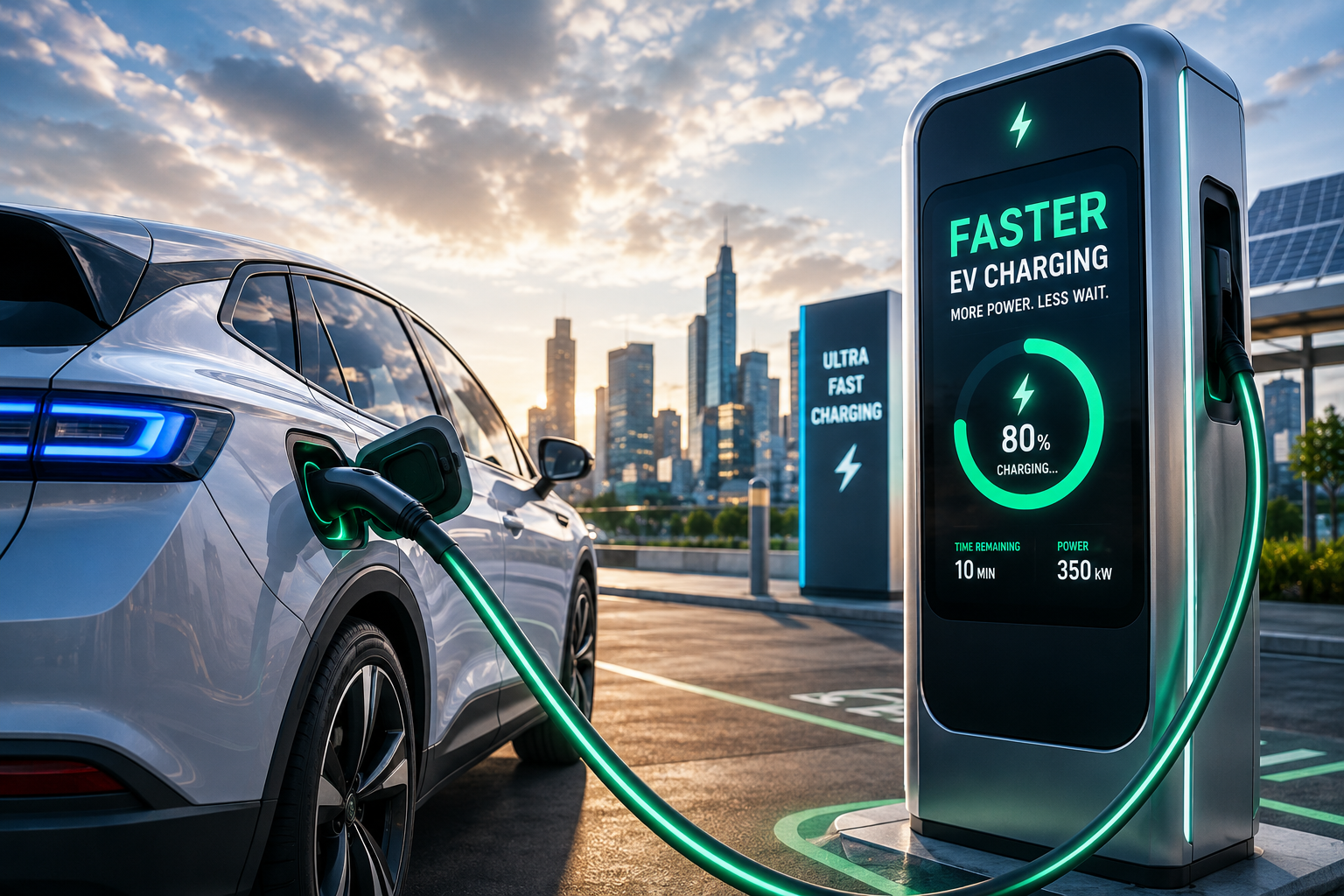

Scientists unveil solid-state battery advance that could dramatically cut EV charging times and boost driving range.
A team of materials scientists announced this week that they have developed a new solid-state battery design capable of charging electric vehicles significantly faster than current lithium-ion technology. The announcement, made during a research briefing, highlights a breakthrough in energy density and thermal stability that could reshape the electric vehicle industry in the coming years. Researchers say the innovation addresses two of the biggest barriers to EV adoption: long charging times and limited driving range. The technology is still in advanced testing but has already attracted interest from major automakers and battery manufacturers eager to bring it to market.
What Makes This Battery Design Different
Unlike conventional lithium-ion batteries that rely on liquid electrolytes, the new design uses a solid ceramic-based electrolyte. This structural change reduces the risk of overheating and allows ions to move more efficiently between electrodes.
Engineers involved in the project say the solid electrolyte also enables the use of lithium-metal anodes, which pack significantly more energy into the same physical space. That means vehicles could travel farther on a single charge without increasing battery size or weight.
Why Faster Charging Could Be a Game-Changer for EV Adoption
One of the most closely watched claims from the research team is a charging time reduction of more than 50 percent compared to existing fast-charging systems. Early lab tests reportedly showed batteries reaching high charge levels in a fraction of the time typically required today.
Industry analysts note that charging speed remains one of the top concerns cited by consumers hesitant to switch from gasoline-powered vehicles. A dramatic improvement in charging times could remove a major psychological and practical barrier to widespread EV adoption.
How Automakers and Investors Are Responding
Following the announcement, several automotive manufacturers reportedly reached out to the research team to discuss potential partnerships and licensing agreements. Battery supply chain companies are also monitoring the development closely, given its potential to disrupt existing manufacturing investments.
Financial analysts caution that scaling laboratory results to mass production remains a significant challenge. Solid-state battery technology has shown promise in research settings before, but manufacturing at commercial volumes has historically proven difficult and costly.
What Comes Next for the Solid-State Battery Technology
The research team says the next phase involves pilot-scale production trials to test durability, safety, and cost efficiency under real-world conditions. Independent verification from third-party labs is expected in the coming months to confirm the reported performance gains.
If the technology proves scalable, experts believe it could reach commercial vehicles within the next several years, though exact timelines remain uncertain. For now, the announcement has energized discussions about the future of clean transportation and the race to build faster, longer-lasting electric vehicle batteries.