
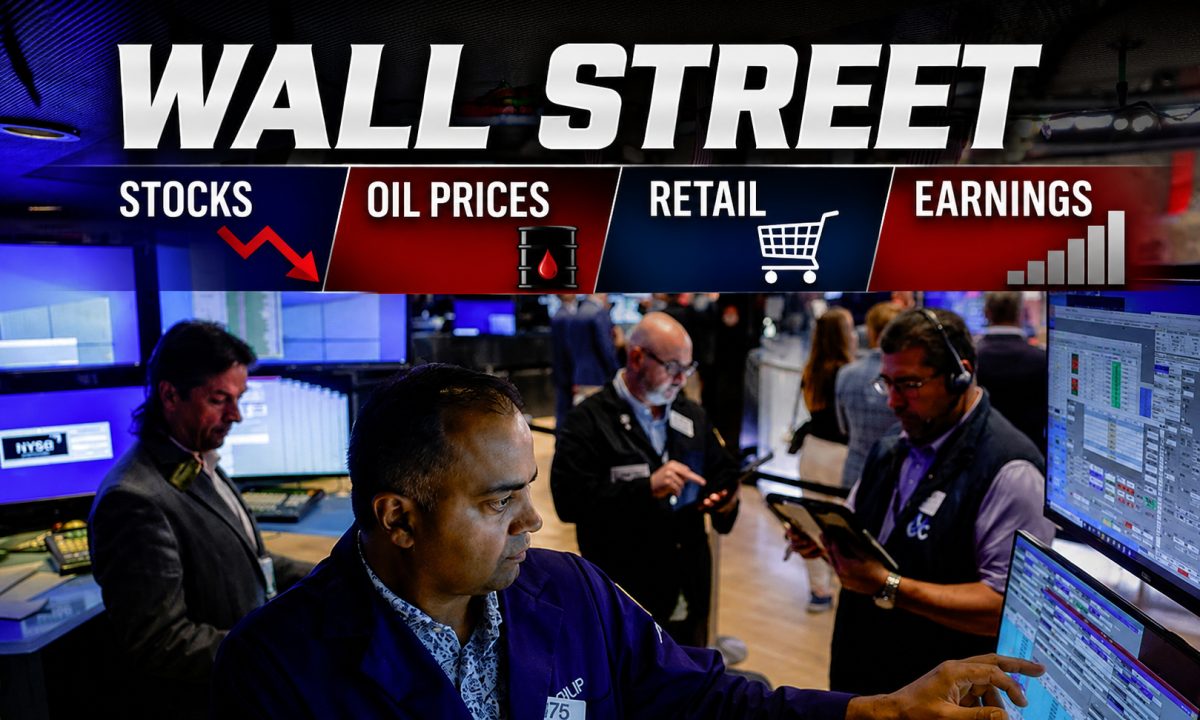

Dow, S&P 500 and Nasdaq end lower as crude jumps and traders brace for retail earnings this week.
Wall Street's three major indexes finished lower on Monday, Aug. 17, 2026, as oil prices climbed on renewed U.S.-Iran tensions and investors held back ahead of a wave of retail earnings expected to reveal the health of American consumers, according to Reuters. The Dow Jones Industrial Average fell 0.51%, the S&P 500 dropped 0.52%, and the Nasdaq Composite slipped 0.31%, Reuters reported in its market wrap. The declines came as traders weighed higher crude prices against uncertainty over upcoming results from Home Depot and Walmart, two retailers whose earnings are widely viewed as bellwethers for consumer spending.
The session extended a cautious mood that had been building across markets in recent weeks, as investors juggled geopolitical risk in the Middle East with mixed signals from the U.S. economy. Reuters said investors were still digesting July's weaker-than-expected retail sales and jobs data, which left traders more guarded heading into this week's corporate reports.
Oil Prices Jump on U.S.-Iran Standoff
Crude oil was the dominant force behind Monday's market weakness. Reuters reported that oil futures settled up more than $2 a barrel as pessimism grew over the prospects of a diplomatic resolution between the United States and Iran, intensifying concerns about global supply. The lack of progress in talks added a fresh layer of risk to markets already sensitive to energy price swings.
CNBC reported that U.S. West Texas Intermediate futures rose 2.6% to $84.50 a barrel, while international benchmark Brent crude futures gained 2.7% to reach $90.87. A separate Reuters market dispatch, capturing an earlier intraday snapshot, showed Brent futures up about 0.3%, with the S&P 500's energy index rising 0.2% in tandem. The moves reflected how sensitive markets have become to any signal on the status of U.S.-Iran negotiations, which have been a recurring driver of volatility in recent sessions.
The oil-driven anxiety followed a similar pattern seen in Reuters' Aug. 14 market wrap, which noted that U.S. and European shares fell as oil rose more than $1 a barrel amid tense U.S.-Iran talks. That report also noted weaker economic data had shifted expectations for Federal Reserve policy, a dynamic that continued to shape sentiment into the following week.
Retailers Take Center Stage This Week
With earnings season entering a critical phase, investors turned their attention to a slate of major retail reports due in the days ahead. Reuters said Home Depot was scheduled to report quarterly results on Tuesday, Aug. 18, 2026, followed by Walmart on Thursday, Aug. 20, 2026. Both companies are seen as key indicators of how U.S. households are managing spending amid a mixed economic backdrop.
Charles Schwab's market commentary for the same week echoed this calendar, listing Home Depot and Walmart among the most closely watched earnings releases. CNBC's coverage similarly flagged a broader slate of retail results as central to the week's market setup, underscoring how much weight investors were placing on these reports to gauge consumer resilience.
The focus on retailers followed a summer marked by uneven economic signals. AP reported that a weak July retail-sales report, released earlier in the month, had already added to uncertainty around consumer demand. That data, combined with a softer jobs report, left investors searching for clearer evidence of whether American shoppers were pulling back or continuing to spend through a period of economic crosscurrents.
Not a Uniform Selloff Across Sectors
While the broad indexes closed lower, the session was not a uniform pullback across all sectors. Reuters' intraday reporting noted that some technology stocks rose after artificial intelligence lab Anthropic issued a strong revenue forecast, which briefly pushed the Nasdaq into positive territory during the day before the index ultimately closed lower alongside the Dow and S&P 500.
That divergence highlighted how the day's weakness was concentrated in areas more directly exposed to oil prices and consumer-spending concerns, rather than reflecting a broad rejection of risk assets. The energy sector, by contrast, benefited from the crude price surge, with the S&P 500's energy index registering a gain even as the wider market retreated.
The Aug. 17 session came after the U.S. market had recently traded near record territory, with Reuters and AP coverage in preceding days showing indexes oscillating as oil prices and Middle East developments repeatedly shifted sentiment. Reuters' week-ahead note had flagged retail sales and inflation-related data as especially significant for shaping consumer-spending and interest-rate expectations, a theme that carried directly into Monday's trading and the earnings reports still to come.